Spread Between French And German 10-Year Government Bond Yields
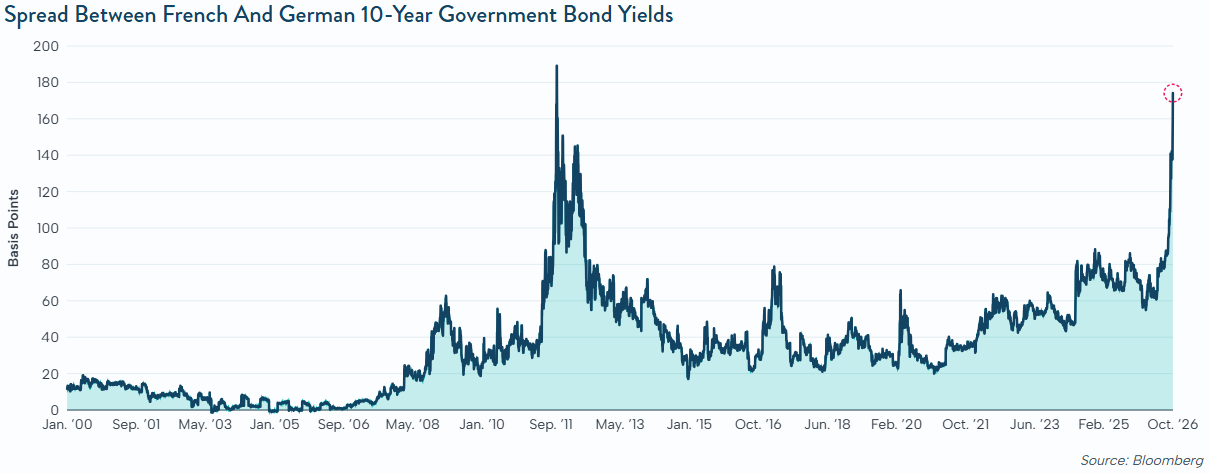
Let’s play a guessing game. Take two countries: Country A carries net debt worth 97% of its economic output; Country B carries 108%, but that’s where the similarity ends. Retirement benefits cost 14% of Country A’s budget, with 18% of the population over 65. In Country B, retirement benefits take up 24% of total government spending, and 23% of residents are 65 or older. More importantly, Country A’s economy has grown 16.3% cumulatively since 2019, while Country B has grown 6.3%. Country A is also outgrowing its 10-year borrowing cost, while Country B’s borrowing cost exceeds its growth. Who are Countries A and B? Jot down your answers before reading on. Ready? Country A is the U.S.; Country B is France. Despite similar debt-to-GDP ratios, France is in a more brittle fiscal position than the U.S., which helps explain why French 10-year OAT yields blew out to 174 basis points above German Bunds this week, the widest spread since the 2011 eurozone crisis. Fiscal sustainability depends on more than spending. As developed economies globally face aging populations, government spending will only rise from here. But the country that grows fast enough, driven by productivity, can sustain higher rates while keeping its debt burden contained.